
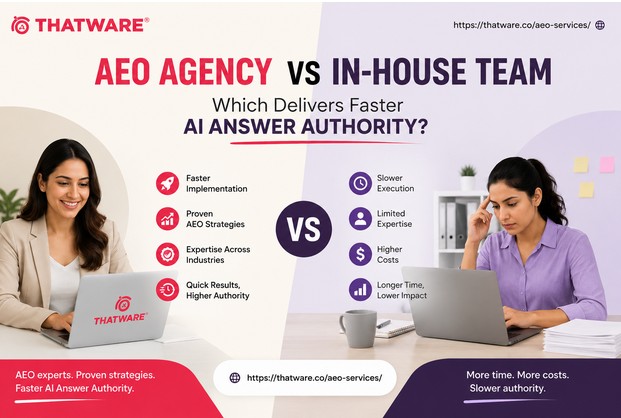
At some point, every marketing leader who gets serious about Answer Engine Optimization faces the same question. Do we hire someone internally to own this? Or do we bring in an agency? It sounds like the same debate that’s played out around SEO, PPC, and content marketing for the last fifteen years. But AEO has some wrinkles that make the calculation meaningfully different.
The short version: the answer depends on where you are, what you need, and what “speed” actually means for your organization. But most companies, at most stages, will move faster with agency support. Here’s why — and when the calculus changes.
What an In-House AEO Hire Actually Involves
Let’s start with the honest reality of building an in-house AEO capability. The skill set you need is genuinely unusual. You need someone who understands how AI systems construct answers — which is partly an NLP/ML literacy question. You need strong content strategy instincts, specifically around question-based and answer-first content architecture. You need SEO technical foundations. And you need the ability to build and execute an entity and structured data strategy.
That combination doesn’t exist in most existing marketing roles. An SEO manager might have some of it. A content strategist might have some of it. A data-oriented digital marketer might have some of it. But someone who has all of it, and has specifically applied it to AEO as a practice? That person is rare, commands a senior salary, and is almost certainly getting multiple offers right now.
Beyond the individual hire, you also need tooling, testing infrastructure, and an ongoing research investment to stay current with a field that’s evolving quickly. AI answer behaviors are not static — the models are updated, the answer patterns shift, the optimization playbook evolves. Staying current is its own ongoing cost.
The Agency Speed Advantage
What a good agency brings to AEO is pattern recognition at scale. A team that has run AEO strategies across dozens of clients has seen what works, what doesn’t, what typically moves the needle in month three versus month twelve, and what pitfalls to avoid. That institutional knowledge is extremely hard to build from scratch in-house, and it can genuinely compress your timeline.
On a fair AEO agency comparison, the speed advantage tends to show up most clearly in the early phase — the audit, the strategy development, the initial implementation. An agency that’s done this twenty times can run a well-structured AEO launch in weeks that would take an in-house team months to architect from the ground up.
The counterargument is that agencies have context gaps. They don’t know your product as well as you do. They don’t live in your industry. Those are legitimate concerns. But they’re manageable concerns — soluble through good onboarding, close collaboration, and clear briefing. The knowledge gap of an external team is fixable. The skill gap and ramp time of a new internal hire is much slower to close.
When In-House Makes More Sense
That said, there are scenarios where in-house ownership is genuinely the right call. The clearest case is when AEO is a core, sustained competitive strategy for your business — not a one-time build, but an ongoing capability you plan to run and iterate for years. At that scale, with that level of strategic importance, building internal expertise makes sense. The investment amortizes over time and the depth of institutional knowledge you accumulate is genuinely valuable.
This typically means you’re in a category where AI answer visibility is a primary acquisition channel, and you’re committed to the long-term investment. That describes a relatively small number of companies, but if it describes yours, the calculation shifts.
Another scenario: you’re in a highly regulated industry where outsourcing content and brand representation requires significant compliance review. In that case, the friction of an external agency may outweigh the speed advantage, and building internal expertise with close legal oversight might be more practical.
The Hybrid Approach Most Companies Should Probably Use
In practice, the most successful AEO programs tend to start with external agency leadership and progressively build internal capability alongside it. The agency drives the initial strategy, builds the playbook, and demonstrates what works. Over time, internal team members get trained and take on increasing ownership of implementation. The agency role shifts from leading to advising.
The best AEO agency relationships are the ones that are genuinely set up to transfer knowledge, not create dependency. If an agency is building the kind of proprietary black box that you can never replicate internally, that’s a warning sign. If they’re building transparent, documented processes that your team can learn from and eventually own — that’s a partnership worth investing in.
The AEO agency vs in-house debate is real, but it’s also somewhat academic for most companies right now. The more pressing question is whether you’re moving at all — because in a space that’s this early and this consequential, speed of entry matters more than organizational structure. Get the strategy running. Figure out the right ownership model as you learn what the work actually requires.
